
Green manufacturing
Paving the way to the future
News
- We will exhibit at "Meet New Solution in TIB 2025"
- Selected for the ILS 2025 TOP 100 STARTUPS
- CTO Mase has been selected as one of the top 2% of the world's most influential researchers.
- We will be exhibiting at the Innovation Leaders Summit 2025
- Hamamatsu City's "FY2025 Hamamatsu City New Industry Creation Project Subsidy Program" has selected us.
Technology
Service
Fine bubble synthesis technology that does not require a pressure vessel
Fine bubble is a generic term for "ultrafine bubbles (UFB)", which are bubbles with a diameter of less than 1 μm, and "microbubbles (MB)", which are bubbles with a diameter of 1 μm or more and less than 100 μm.
Fine bubbles, whose size has been reduced to the nano- or micro-order in this way, exhibit characteristics different from the millimeter-order bubbles we usually see.
- The bubble rising speed is slow, allowing them to be retained for a long time.
- The specific surface area of the bubbles becomes extremely large.
- Bubbles are difficult to coalesce due to the repulsion of surface charges.
- The internal pressure rises due to the self-pressurizing effect, improving gas solubility.
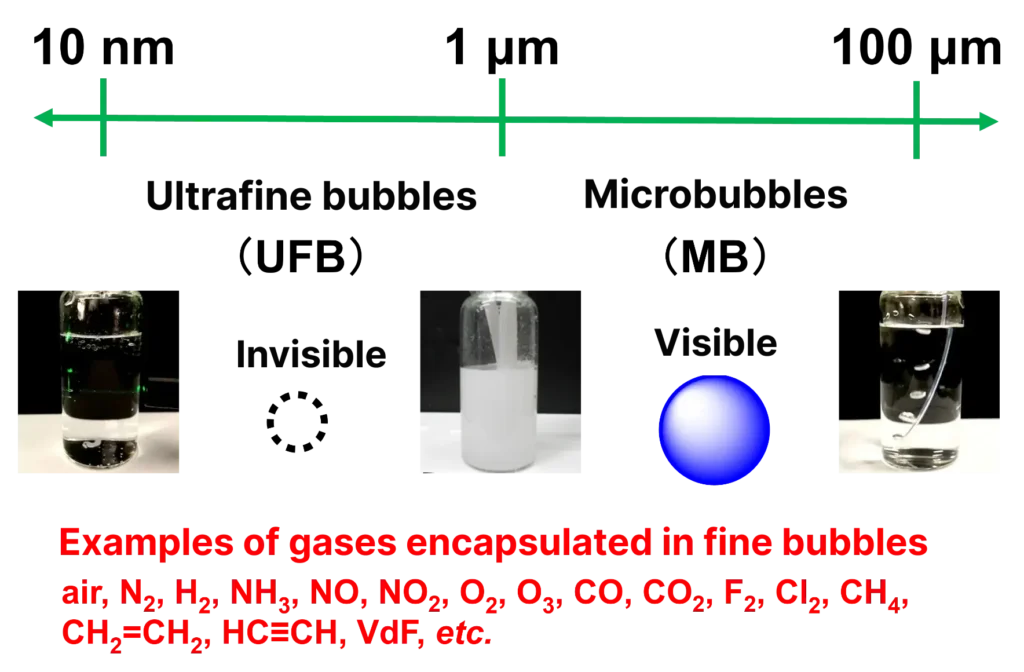
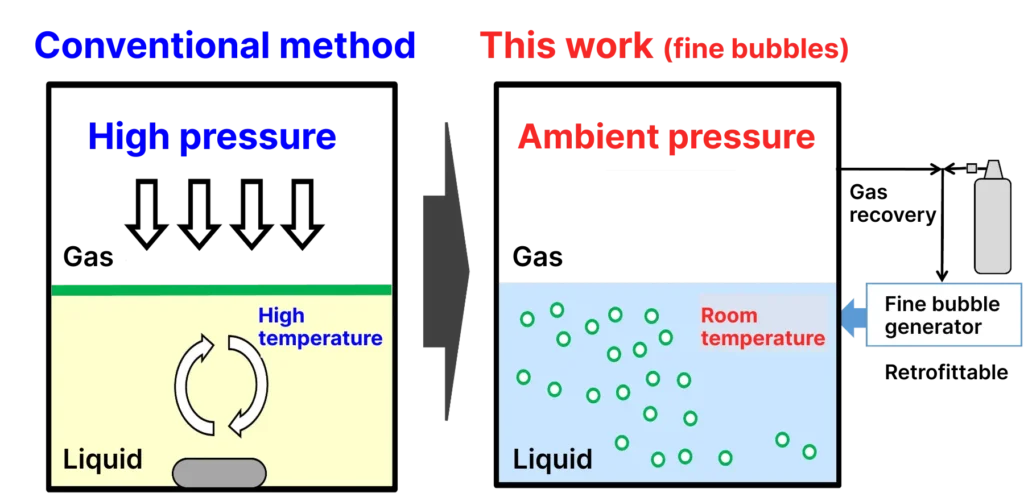
In conventional gas-liquid reactions, it was common practice to carry out the reaction under high temperature and high pressure using a pressure vessel with vigorous stirring in order to maintain a high dissolved gas concentration and high reactivity. However, in modern times—where not only efficiency but also safety and a reduction in environmental impact are demanded—improvements to conventional methods are strongly desired. By creating "fine bubbles" with optimal reaction conditions for various gas components, we have successfully developed a gas-liquid reaction process that operates under normal temperature and pressure and requires no pressure vessel.
Flow reaction technology, which is important for green manufacturing
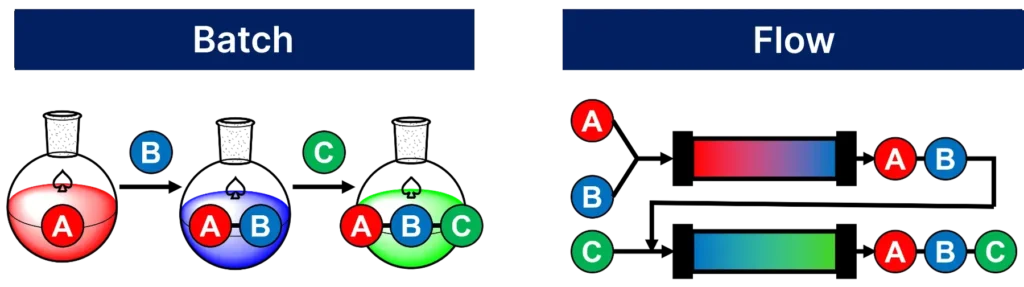
Chemical manufacturing processes are broadly classified into batch and flow types.
A batch process is a method in which the required raw materials are charged into a reaction vessel, and after the reaction is completed, the product is extracted, isolated, and purified. Currently, most chemicals are synthesized by repeating this batch process.
However, since this batch process involves isolation and purification steps of intermediate products in every reaction, it is often a method with low production efficiency and a large environmental impact, and there is a strong demand for an alternative.
On the other hand, flow reactions do not require reaction vessels like those used in batch processes; instead, raw materials are continuously fed in one direction through microscopic channels, carrying out reactions all the way to the final product without the need for isolation or purification. Such flow reactions have the following features, and a shift from batch processes to flow systems is anticipated in the production of various chemicals.
- Improvement of reaction yield (high purity)
- Improvement of response speed (time saving)
- Energy saving
- Low waste generation
- simplicity of reaction control
- Compact and inexpensive equipment
- Excellent safety
- Easy scale-up (continuous production)
- Low cost
Examples of expected reactions to the introduction
- high-temperature and high-pressure reaction
- photoreaction
- nanoparticle and emulsion generation
- reactions requiring precise control
- reactions involving unstable intermediates
- reaction involving hazardous materials
Supporting flow reaction technology
"Microwaves" and "Reaction Condition Optimization Program"
While flow synthesis has various characteristics compared to batch synthesis, it is said to be difficult to introduce into complex reaction processes such as fine chemicals.
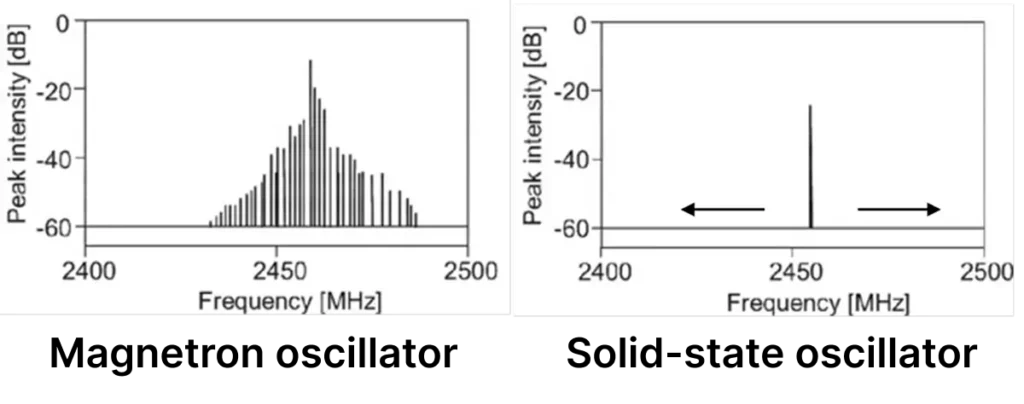
Therefore, to enable flow processing even for complex reaction steps such as those in fine chemicals, we are working on equivalent reactions of target molecules and the reduction of reaction steps through rapid and regioselective heating utilizing microwaves (semiconductor element oscillators).
We are also working on improving yields (and purity) through reaction condition optimization programs that utilize inline analysis and machine learning.
About Us
Bubble&Flow was established to bring the fine bubble and microwave flow reaction technologies developed in Mase Laboratory at Shizuoka University into societal implementation.
Chemicals are used in various places all around us and have greatly contributed to the development of human society up to now.
On the other hand, it is known that chemicals generate large amounts of CO₂ during production, which has become a contributing factor to modern environmental problems.
For us living in the present, innovation in chemical manufacturing is essential to realize a sustainable society.
Bubble & Flow is taking on the challenge of "green manufacturing"—minimizing the E-Factor (waste metric), energy, and costs while maximizing safety, reproducibility, productivity, and selectivity through the full use of fine bubbles, microwaves, flow reactions, and machine learning.
Company Profile
Company Name
Bubble & Flow Co., Ltd.
Business description
Chemical manufacturing utilizing fine bubbles and flow reactions, and development and sales of chemical products
Establishment
June 25, 2024
representative
Representative Director, Nobufuku Kawakami
Director Yoshinori Kinugasa
Director Nobuyuki Mase
major shareholder
Advanced Technology Co-Creation Organization
Team

Representative Director
Nobufuku Kawakami
Joined IGPI after working at a trading company and GE
Co-CEO and Managing Director of Industrial Growth Platform, Inc. (IGPI),
Representative Director, Advanced Technology Acceleration Corporation (ATAC)

Director
Yoshinori Kinugasa
After working at a major chemical company (R&D) and an independent venture capital firm, joined ATAC (Advanced Technology Association Corporation / IGPI Group Advanced Technology Acceleration Co.)
ATAC works hands-on on the social implementation of advanced technology, entrepreneurship support, and startup management.
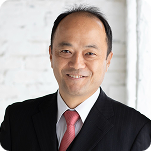
Director
Nobuyuki Mase
Professor, Faculty of Engineering, Shizuoka University / Director, Research Institute of Green Science and Technology
Specializing in organic chemistry, molecular catalysis, and process chemistry, working on green manufacturing
Integrating fine bubbles, microwaves, and flow reactions into synthetic chemistry